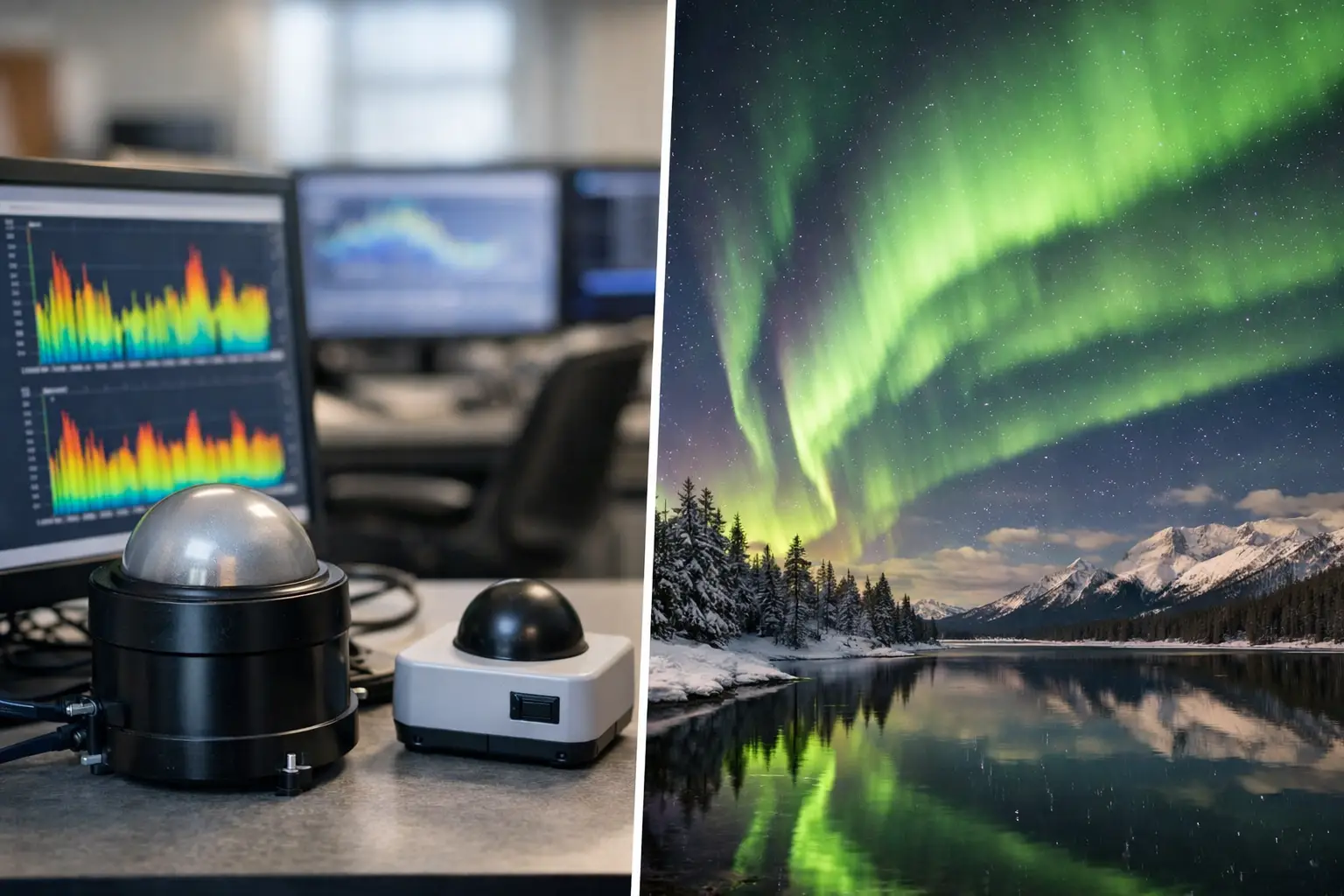
A Kp 6 forecast can look exciting on a travel itinerary and still produce nothing visible from your hotel parking lot. Meanwhile, a modest Kp 2 night can deliver a clear, active aurora in northern Iceland or Finnish Lapland. That is the practical difference behind KP index versus aurora score: one measures global geomagnetic disturbance, while the other should answer the question travelers actually have: Will you see aurora tonight from your location?
The Kp Index remains useful. It is a long-established measure of geomagnetic activity, and it helps show how far south the auroral oval may expand. But it was never designed to be a complete visibility forecast for a specific road, beach, lodge, or camera location. A meaningful aurora forecast combines space weather with the conditions between your eyes and the sky.
KP Index versus Aurora Score: the core difference
The Kp Index is a planetary scale running from 0 to 9. It is calculated from magnetic observations at stations around the world and reported in three-hour blocks. Higher Kp values indicate stronger global geomagnetic disturbance. In general, that means the auroral oval can grow, brighten, or become visible farther from the poles.
For travelers, Kp is best treated as a geographic context tool. In Tromso, Abisko, Fairbanks, Yellowknife, and other high-latitude destinations, aurora can appear at Kp 1 or 2 because these places sit close to or beneath the usual auroral oval. In southern Iceland, a higher Kp may be more helpful because it can bring activity farther south. Even then, it does not guarantee a display overhead.
An Aurora Score is a practical visibility estimate built from several live inputs. Its exact formula can vary by provider, but the useful version asks whether aurora activity is likely to be visible now or soon at a chosen location. It considers the solar wind that drives aurora, the direction of the interplanetary magnetic field, the local geometry of the auroral oval, darkness, cloud cover, moonlight, and weather conditions.
That distinction matters when you have one clear night, a rental car, and a limited window between dinner and sunrise. Kp tells you about the broader magnetic environment. A well-designed score helps you decide whether to leave town, wait for a cloud break, change direction, or stay warm and keep watching the alerts.
What the KP Index tells you well
Kp is particularly useful for trip planning and for setting expectations before you arrive. If you are hoping to see the lights from a lower-latitude destination, a forecast showing elevated Kp can be encouraging. It can also signal that a larger-than-usual auroral oval may create photographic opportunities beyond the most northern viewing areas.
It is also simple to understand. A low Kp usually means that the strongest activity remains near the Arctic, while a high Kp suggests a more disturbed magnetosphere. That simplicity makes Kp popular on travel websites and social media. The problem begins when a single Kp number is presented as a yes-or-no prediction.
Kp has timing limitations. Because it is commonly reported in three-hour periods, it can smooth over short-lived bursts of activity. A vivid 15-minute substorm may happen during an otherwise modest Kp interval. Conversely, a high Kp period can be quiet at the moment you step outside, especially if the solar wind conditions have weakened or turned unfavorable.
Kp is also planetary, not local. It does not tell you whether clouds are covering your horizon, whether it is dark enough, or whether the auroral oval is positioned north of you rather than overhead. It cannot see a snowstorm crossing the road between your accommodation and the nearest clear sky.
Why an Aurora Score can be more useful tonight
Aurora is powered by energy from the Sun arriving in the solar wind. The speed, density, and magnetic properties of that flow affect how efficiently energy enters Earth’s magnetic field. One of the most watched values is IMF Bz, the north-south direction of the magnetic field carried by the solar wind.
A negative, or southward, Bz is generally favorable. It can connect more effectively with Earth’s magnetic field and allow energy to build. Strong solar wind speed and density can add to the potential. These conditions can change quickly, which is why a live score is more actionable than a static Kp forecast alone.
But excellent solar conditions are only half the story. You cannot see aurora through thick cloud. You may struggle to spot a faint display under bright moonlight, particularly when using only your eyes. Local weather, cloud layers, precipitation, wind, visibility, and the timing of darkness all shape the experience.
A useful Aurora Score puts these factors into one decision-ready view. Rather than forcing you to interpret several charts while standing beside a dark road, it can indicate whether the next hour looks promising and why. If the score is low because of cloud, the right move may be to look for a break or a clearer region. If it is low because solar activity is weak, conserving energy for a later window may make more sense.
This is not a promise. Aurora forecasting always involves uncertainty, especially during fast-changing solar wind conditions. The score should be read as a probability-based guide, not a substitute for looking up. A quiet-looking sky can ignite quickly, and a strong signal can fade before the clouds open.
How to read both signals together
Think of Kp as the map scale and Aurora Score as the live driving instruction. Start with Kp to understand whether the broader auroral oval is likely to reach your destination. Then use the live score and its contributing conditions to decide what to do during the night.
For example, a Kp 2 in northern Norway with clear skies, darkness, favorable Bz, and strengthening solar wind may be a very good viewing opportunity. You do not need to wait for Kp 5 before leaving your accommodation. On the other hand, a Kp 6 with complete cloud cover may be a good space-weather event but a poor viewing night where you are.
Photographers should make the same distinction. A high Kp can mean a wider or more energetic oval, but it does not automatically mean a better photo. Clear skies, an open northern view, stable footing, low light pollution, and enough time to set up can matter more than chasing a headline Kp number. A faint, structured arc above a dark fjord can be more rewarding than a powerful display hidden behind clouds.
Your location changes the interpretation. In Iceland, cloud cover can vary dramatically across the island, so a low local score caused by clouds may call for a change of direction rather than an early bedtime. In Alaska or Northern Canada, cold, clear nights may offer excellent visibility even when Kp is modest. In Svalbard, the darkness season and local weather patterns deserve equal attention alongside magnetic activity.
A practical plan for aurora night
Before heading out, check whether darkness overlaps with the best predicted conditions. Confirm the cloud forecast for your exact area and nearby alternatives, then look at the current solar wind and IMF Bz trend. If you are driving, choose a safe route and a legal pull-off before leaving. Never make route decisions by staring at a forecast while driving.
Give yourself enough time. Aurora often begins as a pale gray-green band that is easier to detect with a camera than with the naked eye. Watch the northern horizon, but also scan overhead when activity strengthens. Movement, vertical rays, and a brightening arc are stronger clues than color alone. Your camera screen may show green or purple more clearly than your eyes do.
Keep expectations flexible. If clouds are scattered, wait through short gaps rather than judging the entire night by the first ten minutes. If the score rises because Bz turns southward, be ready to step outside promptly. If it falls, reassess rather than driving farther into poor weather without a clear reason.
For a first trip, a guided Northern Lights tour can reduce the pressure of interpreting weather maps, road conditions, and regional cloud patterns on your own. Independent travelers may prefer the freedom of a rental car, but should plan conservatively around winter driving conditions, fuel, warm layers, and safe viewing areas. The best option depends on your experience, your destination, and how much of the night you want to spend navigating.
The free AuroraVision app brings Live Aurora Score, real-time solar wind, IMF Bz, Kp Index, cloud cover, moon phase, weather, and smart alerts into one view. Use it as a live decision tool rather than waiting for a single Kp number to tell the whole story.
Do not wait for the “perfect” Kp
Many travelers miss a good show because they are waiting for a dramatic Kp forecast. Near the Arctic, regular low-to-moderate activity can be enough, provided the sky is clear and local conditions cooperate. A higher Kp expands possibilities, but it is not a replacement for darkness, visibility, and favorable real-time solar wind.
Check the broad forecast, watch the live conditions, and make a safe plan you can change as the night develops. The most memorable aurora nights often belong to travelers who acted on a clear window at the right moment, not those who waited for the biggest number.