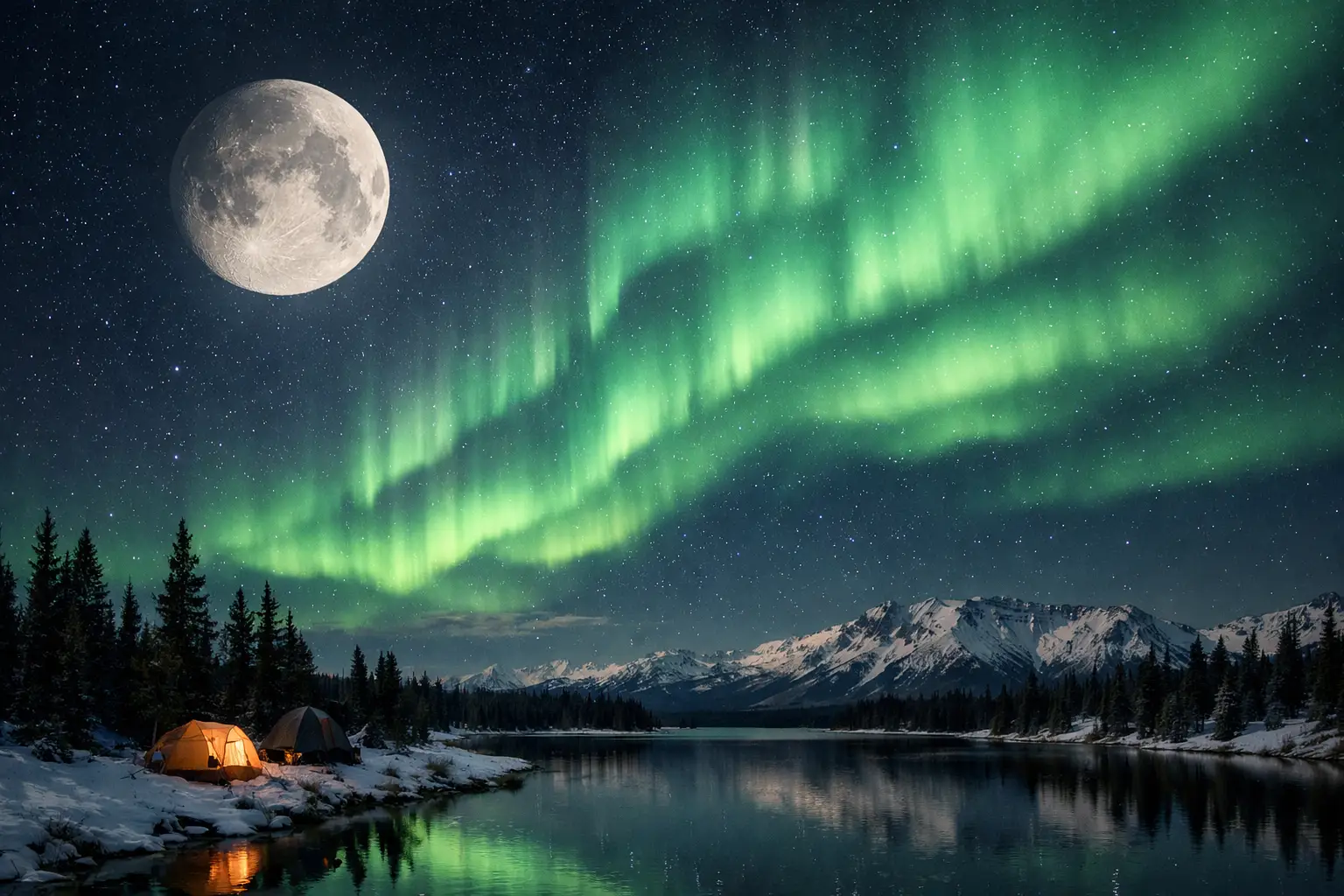
Moon phase aurora viewing can change the look of your night far more than it changes the aurora itself. A bright moon does not turn off the Northern Lights, but it does brighten the sky around them. That difference matters most when the display is faint, the clouds are thin, or you are hoping to photograph subtle colors rather than simply see a strong arc overhead.
The useful question is not, “Is there a full moon?” It is, “How bright will the moon be, where will it sit in the sky, and how strong are the aurora and local conditions tonight?” A strong display can be spectacular beneath a bright moon. A weak display under a dark sky may be easier to see, but only if clouds, city lights, and your viewing location cooperate.
How Moon Phase Affects Aurora Viewing
The moon reflects sunlight, creating a natural source of sky brightness. Around the full moon, that glow can wash out the faintest parts of an aurora display, especially low on the northern horizon. Green arcs may still be visible, but delicate rays, dim gray structure, and weaker red tones can be harder for your eyes to separate from the brighter background sky.
Near the new moon, the sky is darker, giving faint aurora a better contrast advantage. This is why dark-moon dates are popular with photographers and travelers who want the best chance of seeing subtle activity. It is an advantage, not a guarantee. Thick cloud cover will still block everything, and a quiet solar wind period will not become active simply because the moon is absent.
Moon phase is only part of the equation. The moon’s position is equally important. A waxing gibbous moon that sets early can leave several dark hours afterward. A half moon low in the sky may have a modest effect compared with a bright moon high above your viewing direction. In Arctic summer shoulder seasons, lingering twilight can be a bigger obstacle than moonlight.
Full Moon: Better Landscapes, Tougher Faint Aurora
A full moon has a real upside. It illuminates snow, mountains, coastlines, cabins, and roadways, which can make a landscape feel more dramatic and easier to navigate safely. In Iceland, for example, moonlit terrain can create excellent foreground detail for wide landscape photos without heavy artificial lighting.
The trade-off is contrast. If aurora activity is weak or moderate, a full moon can make the display look less vivid to the naked eye. You may see a pale green band where a darker night would reveal more movement and structure. For a major geomagnetic event, however, the moon is rarely the deciding factor. Bright, active aurora can remain obvious even under a nearly full moon.
New Moon: Best for Subtle Detail
New-moon nights favor the darkest possible sky, particularly outside towns and along unlit coastlines, lakes, or mountain valleys. This is the preferred setting for detecting faint arcs, photographing softer colors, and enjoying the depth of a star-filled sky around the aurora.
But darker is not automatically better for every trip. A moonless winter night can make unfamiliar roads, icy trails, and uneven ground more difficult to manage. Travelers driving independently should prioritize safe conditions, legal pullouts, weather, and visibility over a perfect lunar calendar. A guided Northern Lights tour can be a practical choice when you would rather let an experienced local handle changing roads and cloud routes.
Moon Phase Aurora Viewing Is a Contrast Problem
Think of aurora visibility as a competition between light sources. The aurora needs to stand out against the rest of the sky. Moonlight, twilight, nearby towns, vehicle headlights, and even a phone screen all add brightness that reduces contrast.
That is why a low KP Index does not automatically mean a poor viewing night, and a high KP Index does not guarantee visible aurora at your location. KP describes global geomagnetic disturbance over a set time period. It does not tell you whether clouds are above you, whether the IMF Bz is favorable, whether solar wind conditions are strengthening, or whether the moon is bright and high in your exact sky.
For travelers, the practical priority order is usually this: first find clear or clearing skies, then assess real-time aurora conditions, then consider how moonlight and local light pollution affect contrast. A clear sky under modest aurora activity often beats a clouded sky during a more impressive space-weather forecast.
What to Check Before You Leave
Start with the moon phase, but do not stop there. Check moonrise and moonset for your specific location. A bright moon below the horizon is no longer brightening your sky, so the hours before moonrise or after moonset may be your best window.
Then check cloud cover by hour and by map. Clouds are the most common reason travelers miss a display, particularly in coastal and mountainous regions where conditions can shift quickly. Look for breaks, not just a blanket regional forecast. A short drive can sometimes place you under clearer skies, but only if roads and weather make that move sensible.
Finally, watch the actual aurora inputs. AuroraVision brings together a Live Aurora Score with real-time solar wind, IMF Bz, KP Index, cloud cover, moon phase, and weather so you can judge the full picture rather than waiting on one number. Activate alerts before dinner or before settling into your hotel, then be ready to move when the best time tonight begins to improve.
Choose Your Location With Moonlight in Mind
When the moon is bright, get away from artificial lights first. City glow is often more damaging than moonlight because it concentrates near the horizon, exactly where a weaker aurora may appear. A dark beach, rural road turnout, or open valley can make a meaningful difference, provided you can park safely and are not trespassing.
Use the moon direction strategically. If the moon is high in the south and the aurora is expected in the north, place a hill, building, or stand of trees between you and the moon where possible. Do not block the northern horizon, but reduce direct glare. Keep your eyes away from headlights and bright screens for at least several minutes so they can adapt to the dark.
In northern Scandinavia, Greenland, Alaska, and Northern Canada, the aurora can sometimes appear overhead during stronger events. In that situation, you need an open view in every direction, and the moon may be unavoidable. Accept the brighter sky and focus on the activity you have. A dramatic overhead corona is worth seeing under any moon phase.
Photography Changes the Equation
Cameras can record aurora differently from human vision, but moonlight still affects the result. On a bright-moon night, your foreground may be beautifully exposed while the sky becomes too bright during a long exposure. Shorten the shutter speed, lower ISO, or close the aperture slightly to protect highlights and preserve aurora structure.
On a dark new-moon night, the opposite challenge appears: the landscape may be nearly black. You may need a longer exposure or higher ISO for foreground detail, but those choices can blur fast-moving aurora or add noise. There is no single correct setting. Fast, bright aurora generally rewards shorter exposures, while faint, slow activity allows more time.
Bring a tripod, spare warm batteries, and a lens cloth. Set up before the show begins, and avoid shining a headlamp toward other viewers or cameras. If you use a red light, keep it dim and pointed downward.
Plan for the Window, Not the Calendar
Booking an aurora trip around a new moon can be a smart preference, especially for photography-focused travelers. Still, do not reject a full-moon week if it offers better weather, a longer stay, flexible transportation, or access to darker rural accommodations. More nights outside under clear skies usually beat one theoretically perfect night.
Give yourself at least three viewing nights when possible. Keep your plans flexible, stay warm enough to wait, and check conditions again after sunset. The moon changes predictably. Clouds and solar wind do not. That is where patient, real-time decisions can turn an ordinary evening into the moment you came north to see.