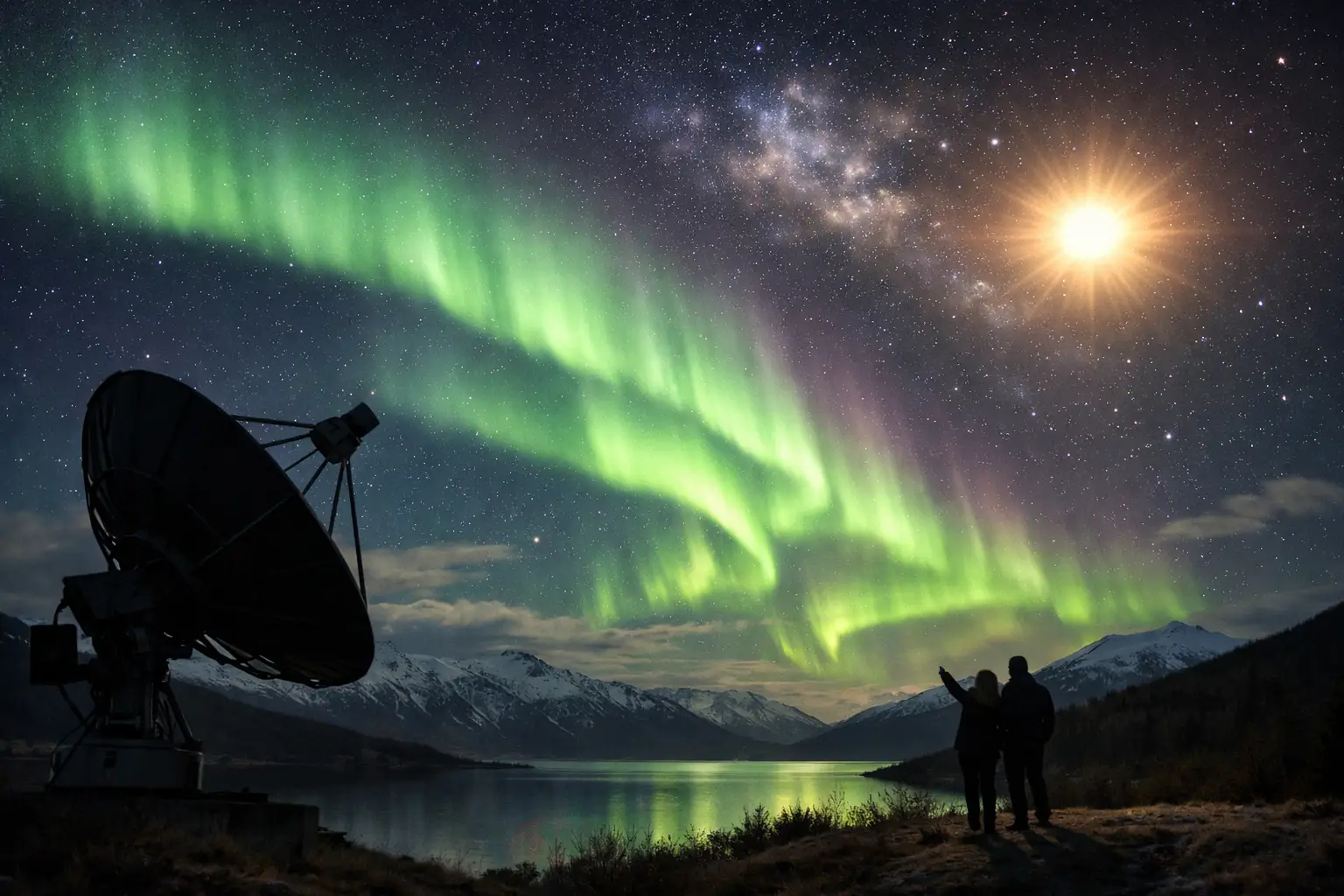
A clear, dark sky over Iceland can still produce a disappointing night if the conditions above Earth are quiet. Space weather is the missing part of the forecast: the activity from the Sun that supplies the energy for the Northern Lights. For aurora travelers, understanding a few live measurements turns a hopeful late-night drive into a better-timed decision.
The goal is not to predict every ribbon of light days in advance. Aurora activity changes quickly, clouds move, and the most useful question is often simpler: Will you see aurora tonight, from where you are, and when should you go outside?
What Is Space Weather?
Space weather describes changing conditions in the space between the Sun and Earth, especially the stream of charged particles called the solar wind. The Sun constantly releases this material, but its speed, density, and magnetic properties are far from constant.
When solar activity sends a stronger or better-aligned stream toward Earth, energy can enter our magnetic environment. That energy travels into the upper atmosphere near the poles, where it excites oxygen and nitrogen atoms. As those atoms release energy, they produce auroral light.
This is why the Northern Lights are not controlled by darkness alone. Darkness is essential for seeing them, but it cannot create them. A cloudless night with weak geomagnetic activity may show only a faint glow, while a strong solar event can produce an active display that remains hidden behind clouds.
The Measurements That Matter for Aurora
A single number cannot describe the whole aurora picture. The most useful live forecast combines several measurements because each answers a different question.
Solar wind speed
Solar wind speed is how fast charged particles are traveling from the Sun toward Earth, usually measured in kilometers per second. Higher speed can help deliver more energy into Earth’s magnetic field, especially when other conditions cooperate.
Speed alone is not a promise. A fast solar wind with an unfavorable magnetic orientation may produce less activity than a slower stream with a strongly favorable one. Think of speed as available momentum, not the on-off switch for the aurora.
IMF Bz
IMF means Interplanetary Magnetic Field, the magnetic field carried by the solar wind. Its north-south component is called Bz, and it is one of the most closely watched real-time values for aurora viewing.
When Bz points southward, shown as a negative value, it can connect more effectively with Earth’s northward-facing magnetic field. This allows solar-wind energy to enter the magnetosphere more easily. A sustained negative Bz is generally more useful than a brief dip, particularly when solar wind speed is elevated.
Bz can turn north or south quickly. That is why a forecast made at breakfast may be much less useful than live conditions checked shortly before heading out.
Solar wind density and pressure
Density tells us how many particles are present in the solar wind. A jump in density can increase pressure on Earth’s magnetic field and sometimes trigger a useful response, especially at the front edge of a solar-wind disturbance.
This measurement is valuable context, but it is not a standalone aurora forecast. High density without favorable Bz may create a short-lived reaction rather than a sustained display. Watch the combination of density, speed, and magnetic direction instead of chasing one dramatic chart movement.
Geomagnetic activity and the KP Index
The KP Index measures global geomagnetic disturbance over three-hour intervals. It is familiar because it is easy to compare, but it has limits for travelers. KP is partly a report of what has happened, not a minute-by-minute visibility forecast for your exact location.
At high latitudes, including much of Iceland, northern Norway, Finnish Lapland, and interior Alaska, visible aurora can occur at modest KP levels when the local sky is clear and darkness is deep. During a stronger disturbance, the auroral oval expands farther south, improving the odds for locations outside the usual aurora zone.
Use KP for broad geographic context. Do not use it as the only reason to cancel a tour, stay in your hotel, or drive two hours into the countryside.
Why Solar Events Do Not All Look the Same
Two common sources can shape aurora conditions: coronal holes and coronal mass ejections, often called CMEs.
Coronal holes are regions of the Sun where fast solar wind can escape more easily. They can create recurring periods of enhanced activity as the Sun rotates, making them useful for medium-range planning. Their effects often arrive as a stream that can last for days, though intensity still varies.
CMEs are large eruptions of solar material and magnetic field. If one is directed toward Earth, it can produce stronger geomagnetic activity, but arrival time and impact are uncertain until it is closer to Earth. A dramatic solar image does not automatically mean a dramatic aurora show at your destination.
For travel planning, this difference matters. Book accommodation in a dark, accessible area based on season and location. Then use real-time space weather to decide whether tonight calls for patience, a short drive away from city lights, or an earlier night and another attempt tomorrow.
Space Weather Is Only Half the Viewing Decision
Aurora activity can be excellent above the clouds. For people standing on the ground, visibility depends on local conditions just as much.
Cloud cover is often the first filter. In Iceland and coastal Norway, fast-moving weather systems can create a narrow clear gap even when a regional forecast looks poor. In inland Finland or northern Canada, clear conditions may be more stable, but cold temperatures and road conditions can become the practical challenge.
Moon phase matters too, although not in the way many travelers expect. A bright moon can wash out faint aurora and reduce contrast in photographs, but it does not stop a strong display. Moonlight can also illuminate mountains, snow, and foregrounds for landscape photography. If activity is high, do not skip a clear night simply because the moon is bright.
Local weather includes wind, temperature, visibility, and road safety. A remote pullout with no safe place to park is not a good viewing site, regardless of solar conditions. On self-drive trips, choose a backup location close to your accommodation and avoid turning an aurora chase into a risky drive.
How to Read Conditions Before You Go Outside
Start with the ground truth: is it dark enough, and is there a clear or clearing sky nearby? If the answer is no, search locally for a safe area with better cloud cover rather than focusing on geomagnetic charts.
If the sky is clear, look at live solar wind and Bz. Higher wind speed, a sustained negative Bz, and elevated geomagnetic activity together improve the chance of an active display. If Bz is positive and activity is quiet, expectations should be lower, though faint aurora may still be present in high-latitude regions.
Then give the sky time. Aurora can intensify in minutes, fade, and return later. A 20- to 30-minute wait is often more revealing than a quick glance from a parking lot. Let your eyes adjust, look north when activity is low, and scan overhead when it strengthens. What appears as a pale gray-green band to the eye may show more color in a camera image, but a camera should support the experience rather than replace watching the sky.
AuroraVision brings Live Aurora Score, solar wind, IMF Bz, KP, cloud cover, moon phase, and local weather into one real-time view, so you can judge the full situation rather than relying on KP alone. Check it before departing, set alerts when you need sleep, and reassess conditions if the clouds or solar wind change.
A Better Plan for an Aurora Trip
Build flexibility into your itinerary. A three-night stay gives you more useful chances than a single fixed evening, and a guided Northern Lights tour can be worthwhile when you prefer a local driver who knows safe routes and microclimates. Independent travelers may prefer a rental car, but should reserve it only if they are comfortable with winter driving rules, changing weather, and limited daylight.
Photographers should prepare before the activity starts: warm batteries, a tripod, a wide lens, and a composition selected while there is still enough light to move safely. Travelers who mainly want the experience can focus on warm layers, a hot drink, and a dark location with an open northern horizon.
The best aurora night is rarely the one with the most exciting headline. It is the night when solar conditions, a clear patch of sky, safe access, and your own readiness all line up. Stay flexible, keep checking the live picture, and be ready to step outside when the moment arrives.